
FP&A Software vs Finance Operating System
Updated: Aug 10

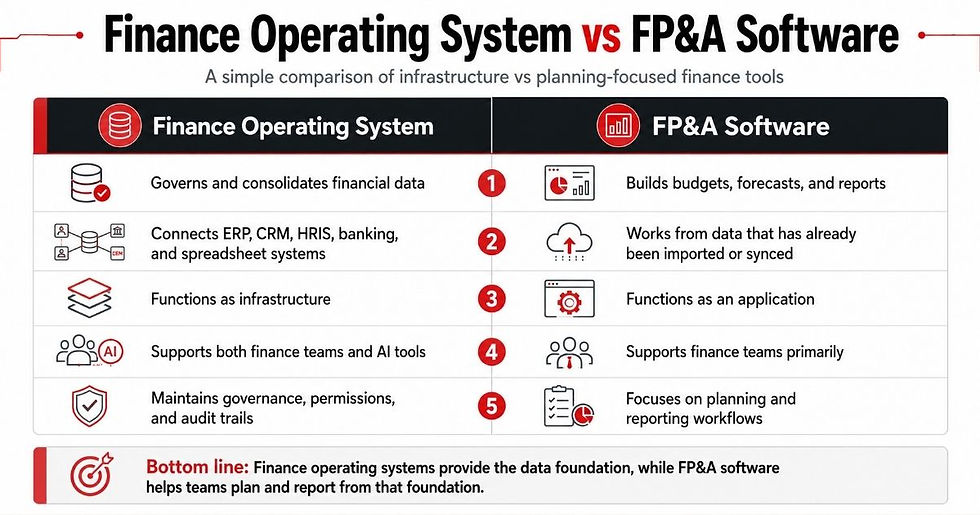
FP&A software and a finance operating system serve different but complementary roles in modern finance. FP&A software helps finance teams create budgets, forecasts, reports, and scenario plans. In contrast, a finance operating system (Finance OS) provides the governed data foundation that connects, consolidates, and manages financial information across the business. Understanding how these technologies work together helps organizations build an AI-ready finance function with stronger governance, better reporting, and more reliable decision-making.
Finance teams experimenting with AI keep running into the same wall: the models are capable, but the data feeding them isn't. Forecasts come out confident and wrong. Board narratives cite numbers nobody can trace back to a source. The bottleneck isn't intelligence but infrastructure.
That's the real answer to what the difference is between FP&A software vs finance operating system. FP&A software is a planning and modeling application that helps teams build budgets, forecasts, and reports. A finance operating system is something else entirely: a governed data layer that sits underneath those applications, consolidating financial information from across the business so that finance teams, analytics tools, and AI agents can all work from the same trusted foundation.
Knowing the positioning of these two matters more now than it did a few years ago, because AI adoption has made the quality of the underlying data (not the modeling interface) the deciding factor in whether finance AI initiatives actually work.
The Structural Difference of FP&A Software vs Finance Operating System
FP&A software is built to calculate. It pulls data in through scheduled imports, flat-file uploads, or API connectors from the general ledger and other source systems, then organizes that data into a proprietary model. It’s typically a multidimensional cube or a relational schema built around accounts, cost centers, entities, and time periods. From there, a calculation engine runs allocations, currency conversion, consolidation eliminations, and driver-based formulas, while a workflow layer manages budget submissions, approvals, and version control.
A finance operating system works upstream of all of that. Instead of ingesting data for a single planning application, it consolidates information from ERP, CRM, HRIS, banking platforms, and spreadsheets into one unified, governed financial data layer, then exposes that layer to finance teams and AI tools through standardized, secure connections.
What Is FP&A Software?
FP&A is the function responsible for budgeting, forecasting, modeling, scenario planning, and reporting. It’s the work that helps a business protect its financial health and steer toward its goals. FP&A typically reports up through the CFO, alongside accounting and treasury, and serves everyone from department leaders to the C-suite with a clear picture of where the company has been, where it stands, and where it's headed.
FP&A software exists to support that function. It replaces spreadsheet-based planning with a dedicated modeling environment, and it solves real problems: manual data collection, slow close and consolidation cycles, forecasts that go stale before they're published, and reporting that never quite keeps pace with the business. What it was never designed to do is govern data at the source, manage access controls across entities, or expose financial information securely to outside AI tools. That's a different problem, and it needs a different kind of solution.
What Is a Finance Operating System?
A finance operating system is a governed data infrastructure layer that consolidates financial and operational data from across an organization, applies controls for accuracy, access, and compliance, and makes that governed data available to AI tools, agents, and workflows through a standardized connection protocol.
It isn't a reporting tool, a planning platform, or an analytical application. It's the layer beneath those things. An ERP records transactions. FP&A software analyzes them. A finance operating system sits in between, making sure every application built on top of the data, human or AI, is working from the same trustworthy source.
It's worth noting that "finance operating system" also shows up in fintech, where it describes platforms that consolidate payments, expense management, and billing into one workflow layer. That's a legitimate definition for a different problem, mostly relevant to startups streamlining how money moves through the business. The infrastructural definition covered here, the one enterprise and midmarket finance teams are increasingly adopting, is about governing financial data for AI, not consolidating financial operations.
How Finance Operating Systems Work
To turn scattered financial records into AI-ready finance data, a finance operating system is generally built on three layers.
Semantic Layer
Raw database fields rarely mean anything useful to an AI model on their own. A semantic layer translates technical data into the financial concepts a business actually uses (revenue by region, gross margin, operating expenses by business unit) so AI can reason about the numbers accurately instead of guessing at what an ambiguous field name is supposed to represent.
Data Integration Layer
This layer pulls financial and operational data continuously from ERP systems, CRM platforms, HRIS, payroll, banking feeds, billing systems, and spreadsheets into a single environment. Rather than querying disconnected systems one at a time, finance teams and AI applications work from one consolidated financial foundation, with consolidation logic (eliminations, FX adjustments, allocations) applied once and maintained centrally.
Governance Layer
This is where role-based access control, audit trails, and data lineage get applied. Every query, whether it comes from an analyst or an AI assistant, can be traced back to a specific source, a specific user, and a specific timestamp. It's what makes AI-generated output defensible in an audit and presentable to a board.
How Finance Operating Systems Support AI
AI is only as reliable as the data it's given, and that gap shows up clearly in the numbers. Gartner's 2025 survey of CFOs found that 84% of finance organizations have implemented or plan to implement AI, yet only a small fraction (only 7%) report a meaningfully high business impact from it. A separate KPMG report on AI in finance found that a large share of finance leaders point to data quality, integration, and system interoperability as their biggest opportunity to get more value out of AI.
The core issue usually isn't AI hallucination. It's that even the most capable model can only reason over what it's handed. If an AI assistant preparing a board deck or answering a CFO's question is working from an outdated spreadsheet, a partial export, or a disconnected system, it can produce answers that sound confident and are still wrong. A finance operating system addresses this by giving AI-governed, consolidated, continuously updated data instead of static files, with permissions, audit trails, and business context already built in.
Model Context Protocol (MCP), an open standard for connecting AI systems to external data sources, is a big part of why this has become practical at scale. A finance MCP server built on top of a governed data layer can expose that data to any AI platform that supports the protocol, so finance teams build the connection once instead of maintaining a separate integration for every tool they adopt. That's what makes the underlying data layer durable even as the AI tools sitting on top of it change.
Do Finance Teams Need a Finance Operating System?
Not every team needs one on day one, but the direction of travel is clear. AFP's 2025 FP&A benchmarking research found that unreliable data and inaccessible data are the two biggest barriers finance teams cite when trying to get their data AI-ready. Separately, Gartner has projected that 60% of AI projects not backed by AI-ready data will be abandoned, and that a large share of organizations either lack or aren't confident they have the right data management practices in place.
The teams most likely to need a finance operating system now are the ones already trying to plug AI into financial workflows such as generating board narratives, running scenario models, or building variance commentary with an AI assistant. Without governed data underneath, those outputs carry real risk. A misattributed revenue decline or a forecast built on a stale assumption isn't an edge case, it's the ordinary failure mode of AI applied to ungoverned financial data. Where traceability is a regulatory requirement rather than a nice-to-have, governance isn't optional.
Choosing Between FP&A Software and a Finance Operating System
The two aren't really competing purchases. A finance operating system supports FP&A software rather than replacing it. Still, if you're evaluating either category, a few questions tend to separate solutions that genuinely govern financial data from ones that simply aggregate it:
Source Connectivity – Does it connect directly to your specific ERPs, banking providers, and HRIS systems, or does it require manual prep work first?
Consolidation Logic – Are intercompany eliminations, FX adjustments, and entity-level permissions handled automatically?
Auditability – Can every AI-generated insight be traced back to a verified source transaction?
AI Interoperability – Does it expose data through an open, standardized protocol that works across multiple AI tools, or does it lock you into one vendor's model?
Business Context – Does it organize financial data into consistent business definitions, such as revenue, gross margin, operating expenses, and business units, so finance teams and AI tools interpret metrics the same way across every report and analysis?
For an organization still running lean on spreadsheets, dedicated FP&A software is often the right next step. For one already trying to make AI a reliable part of financial planning and analysis, a finance operating system is what makes that AI trustworthy enough actually to act on.
The Real Difference Between FP&A Software and a Finance Operating System
FP&A software and a finance operating system solve different layers of the same problem. FP&A software gives finance teams a modeling and reporting application. A finance operating system gives every application (including AI) a governed, consolidated, and auditable foundation of financial data to build on. As AI takes on more of the analytical work finance teams used to do by hand, the platform that governs the data behind it becomes the more strategic investment.


