
OLAP vs ROLAP: What's the Difference in Today's Finance System?

OLAP vs ROLAP comes down to how financial data is stored, analyzed, and scaled. Online Analytical Processing (OLAP) uses prebuilt multidimensional cubes to deliver fast reporting and analysis, while Relational Online Analytical Processing (ROLAP) works directly with relational databases, offering greater flexibility, scalability, and real-time data access. Today, many organizations are moving toward ROLAP-based architectures because they can handle larger datasets, support AI-driven analysis, reduce dependence on rigid cube structures, and adapt more easily to modern FP&A, reporting, and business intelligence requirements.
What Is OLAP?
OLAP was first formally defined by E.F. Codd in 1993, developed during an era when on-premises software was the norm and relational databases lacked the computing power to handle large datasets in real time. OLAP finance systems solved this by pre-aggregating data into multidimensional “cubes”, structured around a fixed set of dimensions such as time, geography, and product lines. This made queries faster, but it also locked organizations into a rigid, pre-defined reporting structure.
Traditional OLAP cube-based platforms typically support between 8 and 12 dimensions. The problem? Real businesses evolve. Mergers happen, new markets open, product lines multiply, and every structural change to the business requires a costly rebuild of the cube, often requiring outside consultants to execute.
What Is ROLAP?
ROLAP takes a fundamentally different approach. Instead of pre-building a fixed data cube, ROLAP finance systems store data in relational tables (rows and columns) using the same underlying architecture as modern data warehouses like Snowflake and Amazon Redshift. A semantic layer then presents this relational data as multidimensional, giving users the analytical flexibility they need without the structural constraints of a cube.
Major platforms, including Oracle and Microsoft Power BI, have shifted toward relational or tabular architectures in recent years. Why? Because scalable finance databases require the ability to join new tables on the fly, add fields without a system overhaul, and query data at any level of granularity, without waiting for nightly cube refreshes. That is exactly what ROLAP delivers.
OLAP vs ROLAP Differences
1. Dimensionality: Fixed Cubes vs. Unlimited Flexibility
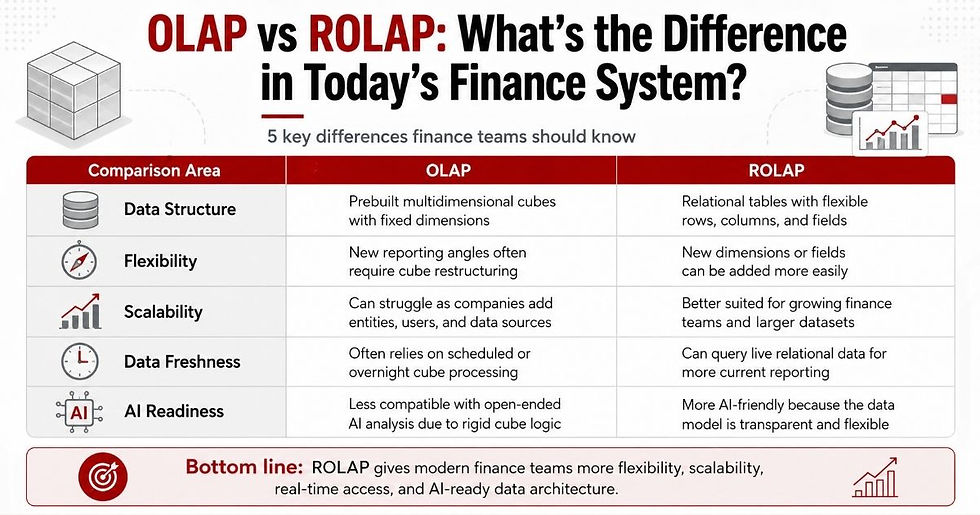
One of the most glaring OLAP and ROLAP differences is how each handles dimensionality. In an OLAP cube, every dimension must be defined upfront. When a business needs to add a new reporting angle—say, segmenting products by color or tracking revenue from a new regional market—the cube must be restructured. This is not a quick fix; it often means recalculating the entire cube hierarchy, a process that can take days and require paid consultant involvement.
ROLAP removes this bottleneck entirely. Adding a new dimension or field is as simple as mapping it into the relational model. Finance teams can pivot their reporting structure whenever business strategy changes, without touching a cube or calling a consultant.
Consider a manufacturer that launches a limited product run in California for a single quarter. In an OLAP system, adding California as a new region allocates storage across every time period in the cube, even empty ones. The following year, when leadership wants to evaluate expanding the California line, the data may have already been merged into a broader "North America" dimension and lost forever. A relational FP&A platform keeps that data accessible and queryable at any time.
2. Finance System Scalability: Why OLAP Falls Short
Finance system scalability is where OLAP limitations become most painful. Cube-based architectures were not designed for the kind of rapid organizational growth that modern companies experience. Adding users, data sources, or entities often means building more cubes, each with its own maintenance overhead and consultant dependency.
ROLAP-based modern finance systems are built to scale. Relational databases can connect to hundreds of data sources (ERP systems, CRMs, payroll tools, and more) without requiring a structural overhaul each time. This makes scalable finance databases genuinely possible for growing businesses, not just an aspiration.
3. Data Freshness: Real-Time vs. Overnight Processing
OLAP cubes typically process data on a nightly schedule. This means finance teams are frequently making decisions based on yesterday’s figures. It’s a serious liability for functions like cash management, revenue forecasting, and expense monitoring. During high-pressure periods like month-end close or annual budget cycles, processing delays and system conflicts make this even worse.
ROLAP systems, by contrast, query live data directly from relational sources. Finance leaders can access current numbers at any time and react to changing business conditions without waiting for the next scheduled cube refresh. This is a meaningful advantage for fast-moving organizations where data freshness is a competitive necessity.
4. Consolidation: Where OLAP Cubes Break Down
Financial consolidation is one of the most critical and most frustrating functions in OLAP finance systems. Intercompany eliminations, multi-entity rollups, and cross-system reporting all require the kind of structural flexibility that cube-based architectures simply cannot provide. Finance teams that run multiple entities on different ERP systems often discover too late that their OLAP platform cannot cleanly consolidate across those boundaries.
When consolidation fails, the downstream consequences are serious: intercompany eliminations get missed, entities don’t roll up correctly, and the numbers leadership relies on may be fundamentally inaccurate. Relational FP&A platforms address this by providing a single, flexible data environment where entities from any system can be mapped together and reported on in a unified view.
Which Is Better for Today’s Finance Teams, OLAP or ROLAP?
For organizations with a stable structure, a small number of reporting dimensions, and no plans to expand or integrate AI tools, OLAP cube systems may still be serviceable. But for the vast majority of modern finance teams, those dealing with growth, M&A activity, new markets, or AI-driven analytics, ROLAP is the superior architecture.
The limitations of OLAP cubes in practice include:
Rigidity: 8 to 12-dimensional caps that require consultant-led rebuilds to change.
Scalability Gaps: Unable to grow with your chart of accounts or entity structure.
Consultant Dependency: System changes require expensive third-party engagements.
Stale Data: Nightly processing cycles that leave finance teams working with outdated figures.
Consolidation Limitations: Multi-entity reporting often fails or requires manual workarounds.
ROLAP eliminates each of these pain points. It gives finance teams direct ownership of their data models, the ability to make changes instantly, and a relational structure that integrates cleanly with the rest of the modern data stack.
Why Finance Teams Are Moving from OLAP to ROLAP
The migration from OLAP to ROLAP systems is accelerating across industries. Finance leaders who have made the switch frequently cite the same core reasons. They wanted to stop paying consultant fees for routine model updates, they needed their reporting structure to evolve as fast as their business, and they wanted data that was accurate right now, not as of last night.
One of the most telling signals is what happens during fast-growth phases. OLAP-based platforms can buckle under the weight of rapid expansion (new cost centers, new entities, new compensation plans) because each change requires a structural intervention. ROLAP-based modern FP&A platforms are designed for exactly this scenario: add a table, map a field, and move on.
The benefits of ROLAP in finance are not just technical. They translate directly into faster cycle times, more accurate reports, lower total cost of ownership, and a finance function that is genuinely in control of its own data.
Why AI Works Better with ROLAP Systems
Perhaps the most forward-looking reason to move away from OLAP is its fundamental incompatibility with AI. As AI tools become standard in finance workflows, from automated variance analysis to natural language querying, the underlying data architecture needs to support open-ended reasoning, not just predefined questions.
OLAP cubes are pre-built structures that encode logic in ways that are opaque to AI engines. The more cubes a system uses to answer a single question, the more that logic fragments across hidden relationships, creating gaps that AI tools cannot reliably bridge. The result is degraded accuracy and limited analytical capability.
ROLAP systems expose a single, transparent data model. An AI can see how data is structured, trace how calculations are derived, and reason over any question the finance team asks, without needing to reverse-engineer a web of cube relationships it was never built to interpret. This is why how ROLAP improves financial reporting goes beyond speed and flexibility, it future-proofs the finance function for a world where AI is a core part of the analytical workflow.
As the CEO and Co- Founder of Datarails Didi Gurfinkel described it, the relational model provides “an unlimited environment, a database with endless dimensions, endless columns and rows, and full flexibility” that lets AI freely explore and update financial data in real time. OLAP, built for a pre-AI world, simply was not designed to support this.
ROLAP Is the Architecture for Modern Finance
The OLAP vs ROLAP question has a clear answer for most modern finance organizations: ROLAP wins on every dimension that matters today. Unlimited dimensionality, real-time data access, seamless scalability, clean consolidation, and AI compatibility make relational online analytical processing the foundation of choice for any team serious about building a high-performance, future-ready finance function.
Legacy OLAP-based tools were built for a different era, one where data volumes were smaller, business structures were more static, and AI was not part of the equation. That era has passed. Finance teams that continue to operate on cube-based platforms are not just dealing with technical constraints; they are accepting a structural ceiling on what their function can achieve.
Before committing to any FP&A platform, ask the right questions:
Can the finance team make structural changes without a consultant?
Is data updated in real time or on a nightly lag?
Can the system consolidate across entities on different ERPs?
If the answers involve project timelines, implementation partners, or cube rebuilds, you’re looking at an OLAP problem. ROLAP is the solution.


