
How to Do FP&A in Different Stages of Business
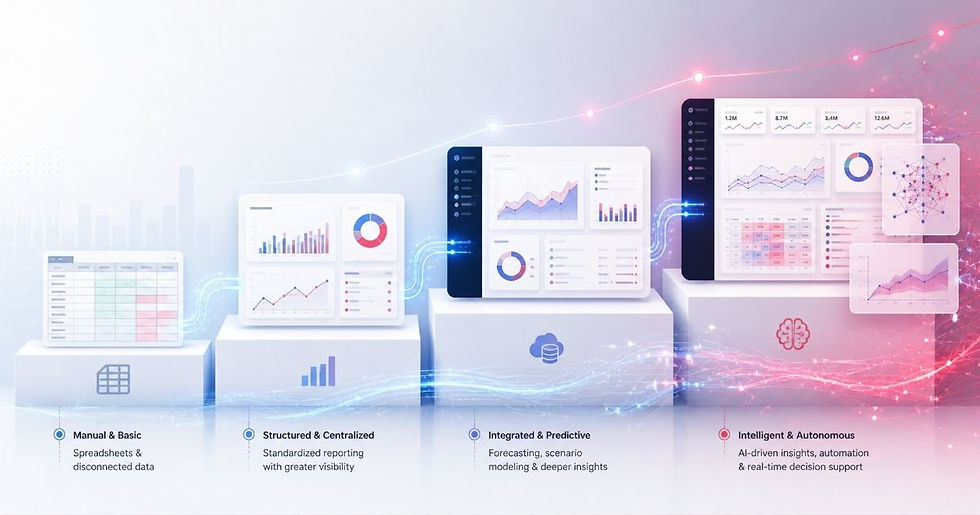
Understanding Financial Planning & Analysis (FP&A) in different stages of business means recognizing that what counts as "excellent" shifts as your company scales, your complexity grows, and your stakeholders' expectations evolve. FP&A is not a static discipline. The way a five-person startup approaches forecasting looks nothing like what a publicly listed enterprise requires, and that gap is intentional.
According to Gartner's 2025 research, only 3% of organizations have fully harmonized their strategic, operational, and financial planning processes. That statistic hints at a widespread tendency to apply yesterday's FP&A playbook to today's business, and suffer for it. The antidote is a stage-aware approach of building the right capabilities at the right time, not chasing a one-size-fits-all standard of excellence.
Why FP&A Is Not One-Size-Fits-All Excellence
Every business moves through recognizable phases:
Startup
Growth
Maturity
Renewal or reinvention
FP&A in Different Stages of Business
Each phase carries different financial risks, different data volumes, and different demands on the planning function. FP&A must evolve alongside the business, not ahead of it, and certainly not behind it. There is a maturity model that formalizes this idea, defining five progressive stages:
Basic
Developing
Defined
Advanced
Leading
But it maps neatly onto the practical realities of business life cycles. A startup operating at the "Basic" stage isn't failing; it's appropriate. A mature enterprise still running annual static budgets, however, is falling dangerously behind. The key insight for finance leaders highlights that stage-specific priorities matter more than universal benchmarks.
FP&A at the Startup Stage
At the earliest stage, FP&A is typically a one-person operation, often the CFO or founder themselves. Resources are limited, tooling is minimal, and time is scarce. World-class financial infrastructure is not just unrealistic, it's also probably counterproductive.
What Good FP&A Looks Like Here
The primary job of FP&A at a startup is to give leadership enough reliable data to make sound decisions. That means a clean P&L, a trustworthy source for actuals, and a basic annual budget that is directionally right, even if not perfectly integrated. A close cycle of one to three business days is achievable because the business is still simple enough to fit inside one person's head.
Agility is the startup's greatest financial asset. With minimal bureaucracy, scenario modeling can happen on the fly. KPIs may live in someone's head rather than a formal dashboard, and that's acceptable, as long as board-deck numbers can be trusted.
What to Avoid
The biggest risk at this stage is premature optimization. Investing in complex tools, elaborate governance frameworks, or multi-layered approval cycles before the business has outgrown spreadsheets wastes capital and slows decision-making. Version control through consistent file naming is sufficient. Reactive data governance is normal.
When to Invest in FP&A Tools
At the startup stage, a well-maintained spreadsheet connected to your accounting software is often adequate. The priority is one trustworthy data source instead of a sophisticated tech stack.
FP&A for Scaling Businesses
As a business enters its growth phase (typically Series B or C for venture-backed companies, or the "rapid growth" stage for bootstrapped businesses), complexity creeps in from every direction. Revenue may have doubled, but the close cycle has become three times harder. New products, new markets, and new investors all increase the demand for faster and more nuanced financial insight.
FP&A Scaling Challenges at This Stage
The central tension for FP&A at a growing company is maintaining agility while building the structures that prevent chaos. More stakeholders mean more sign-offs, which naturally erodes decision velocity. The processes and workarounds that were functional at the startup stage start breaking down under the weight of a more complex business.
This is the stage where integration becomes critical. Revenue, headcount, and operating expense models that once lived in separate spreadsheets need to start talking to each other. A monthly forecasting cadence replaces purely annual budgeting. Driver-based inputs for key revenue lines become essential for accuracy and speed.
How to Scale the FP&A Team
At this point, the finance team should be expanding beyond one generalist. Dedicated FP&A analysts, a defined close process (ideally five to seven business days), and a centralized, governed source of truth for financial and operational data all become necessary infrastructure. Automated data feeds should begin replacing manual CSV exports.
Critically, FP&A must start fighting for a seat at the strategic table. Cross-functional collaboration requires structure and explicit linkage between strategy and the plan, because physical proximity to the CEO no longer does the coordination work.
When to Invest in FP&A Tools
The growth stage is when FP&A tool investment starts to pay off. Automated data pipelines, BI reporting, and integrated planning platforms reduce the manual burden and protect speed as complexity grows. The budget cycle should ideally be completed within three months, not stretch to six.
FP&A for High-Growth and Mature Companies
For businesses with revenues north of $100M (or those operating in a mature phase with multi-entity structures, international operations, or post-M&A complexity), the nature of FP&A changes fundamentally. The question is no longer whether governance and integrated planning exist. It's whether they will hold up at the next stage of scale, whether that means an IPO, a strategic acquisition, or sustained enterprise expansion.
FP&A Best Practices at This Stage
At the mature or late-growth stage, FP&A evolves from a reporting function into what might best be described as the orchestrator of enterprise performance. Finance teams are no longer passive collectors of data. They are now real-time signal processors who continuously translate operational inputs into forecast updates and resource allocation decisions.
This is commonly referred to as the "Leading" stage: planning becomes continuous and scenario-driven, supported by real-time recalibration of forecasts based on live operational signals. Fully integrated planning across financial, operational, and strategic dimensions (supported by a centralized data infrastructure) ensures consistency, traceability, and real-time accuracy.
Practically, this means:
Closing the books in under ten business days with full consolidation and audit readiness.
Recurring reports are fully automated.
FP&A time shifts away from building decks toward interpreting results, proactively flagging risks, and developing audience-aware narratives with recommended actions.
Driver-based models carry forecast-versus-actual feedback loops.
Scenario libraries covering baseline, downside, regulatory, and ESG-adjusted cases enable rapid impact assessment when conditions shift.
ESG and Financial Planning Convergence
At this stage, ESG metrics are no longer footnotes. Carbon intensity, energy efficiency, and sustainability-linked capital expenditure targets need to be embedded directly into planning logic, influencing investment decisions and operating targets alongside traditional financial drivers.
How to Scale the FP&A Team at the Enterprise Level
A mature FP&A function typically includes five or more dedicated professionals, with clear role specialization across reporting, modeling, business partnering, and data governance. Strategic portfolio management, formal intake processes with service-level agreements, and co-ownership of resource allocation with business units are all markers of a high-functioning enterprise FP&A team.

Where Does Your Organization Belong?
Understanding where your organization sits on the FP&A maturity spectrum is a prerequisite for knowing what to prioritize next. The five-stage model (Basic, Developing, Defined, Advanced, and Leading) maps cleanly to the business life cycle described above:
Basic and Developing Stages – This corresponds to the startup phase, where spreadsheet-based processes, annual static budgeting, and limited automation are the norm. ESG is largely absent from planning logic.
Defined and Advanced Stages – This stage aligns with the growth phase, where rolling forecasts are introduced, BI tools are adopted, driver-based modeling emerges, and ESG drivers begin to appear in planning frameworks.
Leading Stage – This stage corresponds to the mature enterprise, where continuous reforecasting, full automation, narrative-driven reporting, and ESG-financial convergence define the planning environment.
Assessing your current maturity honestly across dimensions such as forecasting cadence, data integration depth, automation levels, cross-functional ownership, and ESG alignment reveals the concrete gaps that should drive your next investment cycle.
What to Build Next?
The organizations that consistently outperform their peers are not the ones with the largest teams or the most expensive tools. They are the ones who invest in the right capabilities at the right time.
An early-stage company that builds a clean, trustworthy data foundation while protecting its decision-making speed can perform like a company a stage or two ahead of its headcount. A growth-stage business that automates the right reporting workflows and invests in financial storytelling can operate with the discipline of a public company without the bureaucracy.
The path forward always starts with the same question: What does excellent FP&A look like for my specific stage, right now?
As organizations advance toward the Leading stage, the next frontier is Integrated AI FP&A. This is the stage where a modular, AI-enabled planning environment extends human-driven capabilities through machine learning, signal-triggered data orchestration, and autonomous scenario switching. In this model, a signed contract in the CRM immediately updates revenue forecasts, staffing projections, and margin analyses without manual input. When key metrics fall outside defined thresholds, the system proposes alternative scenarios and alerts decision-makers in real time.
But even the most sophisticated AI-driven planning environment depends on the foundations built at earlier stages:
Clean data.
Shared ownership of forecast inputs.
Standardized assumptions.
A culture of planning fluency across the organization.
Those fundamentals are what make the technology work, and they have to be earned stage by stage. FP&A in different stages of business is ultimately about fitness for purpose. Build what the business needs now, lay the groundwork for what it will need next, and resist the temptation to skip ahead.


