Cash Management Solutions for Businesses

Cash management solutions for businesses enable finance teams to monitor liquidity, forecast future cash positions, and mitigate risk in an increasingly uncertain economy. As CFOs prioritize visibility, control, and resilience, modern cash management software solutions go beyond tracking balances to deliver real-time forecasting, automated consolidation, and scenario analysis.
The best cash management solutions enable leaders to understand not only where cash stands today, but also how operational changes, delayed payments, or cost shifts will impact liquidity weeks or months in advance.
What Are Cash Management Solutions?
Cash management solutions are systems and processes that help organizations monitor, forecast, optimize, and control cash inflows and outflows. At a basic level, they track balances and transactions. At a more advanced level, they integrate operational data, automate forecasts, and provide forward-looking insights that support executive decisions.
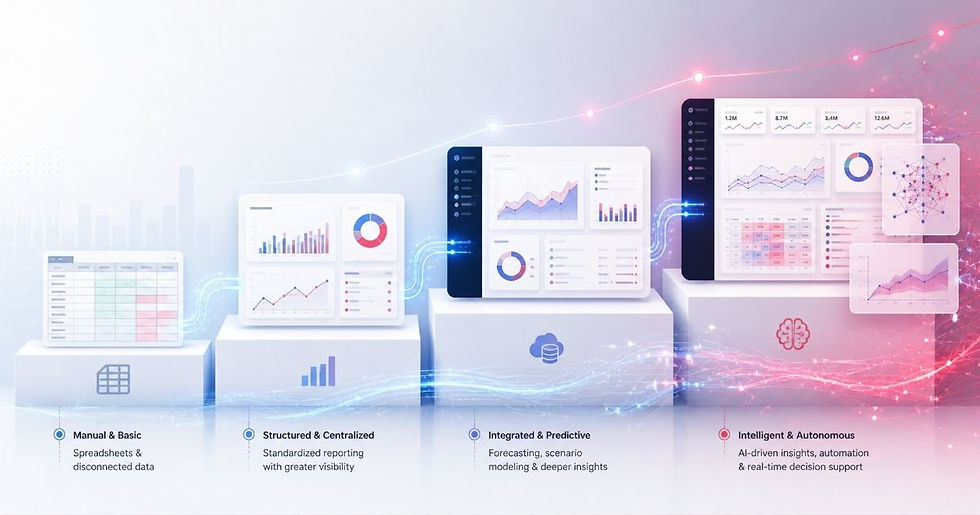
Traditional approaches relied heavily on manual spreadsheets, bank exports, and point-in-time reporting. While those methods still exist, they often fail to keep up with the pace of modern businesses. Today’s cash management software solutions combine data from ERP systems, billing platforms, payroll, and banking tools to provide a single, reliable view of liquidity—both today and months into the future.
For finance leaders, the real value lies not just in seeing current cash positions, but in understanding why cash moves the way it does and what could happen next under different scenarios.
Why Cash Management Is Now a CFO Priority
Recent shifts in CFO business sentiment show a growing emphasis on resilience over aggressive expansion. CFOs are expected to protect downside risk, manage working capital tightly, and ensure the business can withstand volatility without sacrificing long-term strategy.
Cash management sits at the intersection of these goals. Poor visibility can lead to missed opportunities, unnecessary borrowing, or delayed investments. Strong cash controls, on the other hand, allow finance teams to redeploy capital confidently, whether toward growth initiatives, debt reduction, or operational stability.
This explains why many organizations are moving beyond basic bank dashboards and adopting automated cash management solutions that support continuous forecasting, variance analysis, and scenario planning.
Core Capabilities That Matter in Cash Management Software
Not all tools labeled as “cash management” deliver the same value. The most effective solutions share a few critical characteristics.
1. Centralized Data Integration – Cash cannot be managed in isolation, it depends on receivables, payables, payroll, and financing activities. Solutions that pull data directly from ERP, CRM, and banking systems reduce manual work and improve accuracy.
2. Support Forward-looking Forecasting – It’s not just balance tracking. CFOs need rolling cash forecasts that update as assumptions change, not static weekly or monthly snapshots.
3. Enable Scenario Modeling – Finance teams must test outcomes such as delayed collections, increased costs, or changes in revenue timing to understand liquidity risk before it materializes.
4. Governance and Auditability Matter – Cash decisions are high-stakes, and leaders need confidence in the numbers, assumptions, and approval processes behind every forecast.
Best Cash Management Solutions for Businesses
1. Datarails Cash
Datarails Cash stands out as a leading solution for organizations that want enterprise-grade cash visibility without abandoning Excel. Built for finance teams that already rely on spreadsheets, it automates data consolidation while preserving the flexibility analysts need.
What sets Datarails Cash apart is its focus on driver-based, scenario-aware cash forecasting. Teams can model inflows and outflows using operational drivers, test assumptions in real time, and generate executive-ready insights without rebuilding models each period. The platform also incorporates AI to surface anomalies, explain variances, and highlight liquidity risks early.
2. Kyriba
Kyriba is often associated with treasury-focused cash management, offering deep integrations with banks and financial institutions. Its strength lies in real-time cash positioning, payments, and risk management across global accounts.
For organizations with complex banking structures or foreign exchange exposure, Kyriba provides strong controls and visibility. However, its forecasting capabilities are typically more treasury-centric and may require additional effort to connect operational drivers to cash outcomes.
3. HighRadius
HighRadius approaches cash management from the order-to-cash and receivables side, making it particularly strong for organizations where delayed collections are the biggest constraint on liquidity. Rather than starting with bank balances alone, HighRadius focuses on improving when cash arrives by automating invoicing, collections, dispute management, and cash application.
Its AI-driven models analyze customer payment behavior, predict delays, and prioritize collection efforts based on the likelihood of payment. For finance teams, this creates a more accurate picture of short-term cash inflows and reduces the uncertainty that often undermines cash forecasts.
4. Float
Float is a lighter-weight cash flow forecasting tool designed for small and growing businesses. It connects to accounting systems and provides visual cash forecasts that are easy to understand and maintain.
While it lacks advanced modeling or enterprise governance features, Float offers clarity and speed for teams that need basic forward visibility without complexity. It’s often used by founders and finance managers rather than full FP&A teams.
5. NetSuite Cash Flow Management
NetSuite includes cash management capabilities within its broader ERP suite, allowing users to forecast cash directly from transactional data. This tight integration reduces reconciliation work and ensures consistency across financial reports.
However, ERP-native tools can be less flexible for scenario modeling or custom forecasting approaches. Many finance teams still export data into spreadsheets for deeper analysis. NetSuite’s cash tools are most effective for organizations committed to ERP-first workflows.
6. Agicap
Agicap is designed for finance teams that need clear, short-term cash visibility across multiple bank accounts, entities, and currencies without the complexity of enterprise treasury systems. Its core strength lies in consolidating real-time bank data and translating it into rolling cash forecasts that are easy to update and understand.
Instead of relying on static spreadsheets, Agicap automatically pulls balances, expected inflows, and upcoming outflows into a single view. This makes it easier for finance leaders to answer practical questions such as whether payroll is covered next month, how upcoming supplier payments will impact liquidity, or how cash positions differ across subsidiaries. While it does not replace FP&A platforms or deep scenario planning tools, it works well alongside them by providing a reliable, day-to-day picture of cash positions.
How CFOs Should Evaluate Cash Management Software
Choosing the right cash management solution depends on more than feature lists. CFOs should assess how well a tool fits their decision-making style, data environment, and organizational maturity.
Key questions include:
Can the tool adapt to changing assumptions quickly?
Does it integrate cleanly with existing systems?
How transparent and auditable are forecasts?
Does it support scenario-based thinking, not just reporting?
Ultimately, the best cash management solutions for businesses are those that improve confidence, speed, and clarity in financial decisions, especially during uncertain times.
Whether through Excel-based platforms like Datarails Cash, treasury-focused tools, or ERP-native solutions, businesses that invest in the right cash management software solutions are better positioned to navigate volatility and seize opportunities with confidence.