
A Buyer’s Guide for the Top 10 FP&A Software 2026
Updated: Sep 2
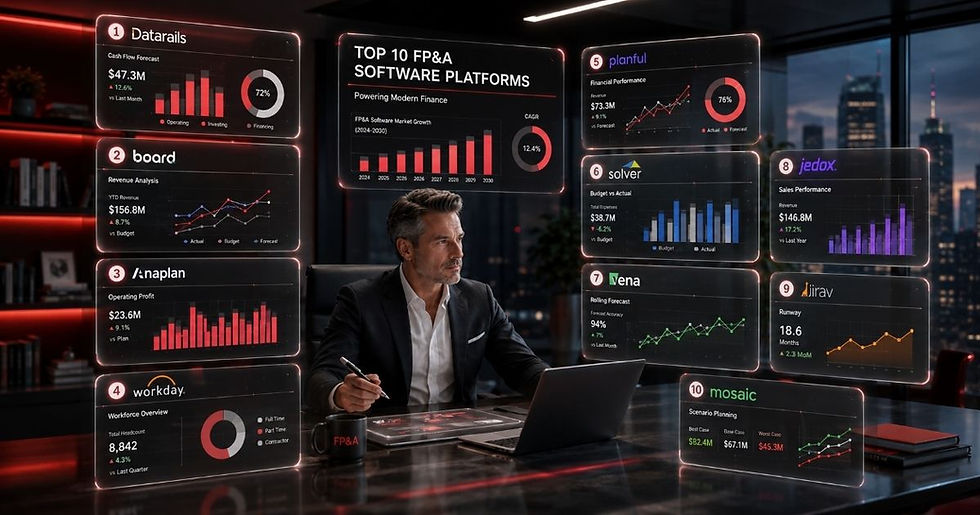
This buyer's guide for the top 10 FP&A software ranks the platforms finance leaders are relying on in 2026, covering what each tool does well, how its AI for finance capabilities stack up, and who it's really built for.
We ranked each one based on its AI capabilities (actual AI tools, not just chatbots and add-ons), ease of use, Excel and other native integrations, time to implement, and governance and data security.
So let's jump right in to the rankings...
Contents
FP&A Software | Best For | Excel Integration | Standout AI Feature |
Datarails | SMBs modernizing FP&A without leaving Excel | Yes (Excel-native) | FinanceOS AI-agnostic governance layer |
Board | Enterprise integrated business planning | No | Role-based AI agents (FP&A, Accounting, Supply Chain) |
Anaplan | Large, complex connected planning | No | Anaplan Forecaster and CoModeler |
Workday Adaptive Planning | Existing Workday customers | No | Workday Illuminate agent suite |
Planful | Mid-market and enterprise CPM | No | Predict engine (Signals & Projections) |
Solver | Microsoft Dynamics 365 and NetSuite users | Partial (Excel reporting) | Solver Copilot AI |
Vena | Excel-first SMB to enterprise teams | Yes (Excel-native) | Vena Omega AI agent team |
Jedox | Multi-entity organizations that are scaling | Partial | JedoxAI agents |
Jirav | Small and mid-sized businesses | No | Jirav Intelligent Forecasting |
Mosaic (Bob Finance) | SaaS and growth-stage companies | No | AI forecasting with Canvas Reporting |
The Top 10 Best FP&A Software Tools
Below is our FP&A software comparison of the ten best FP&A software tools for finance teams this year, each bringing its own take on AI forecasting, AI agents, and predictive analytics to the planning process.
Datarails

Datarails is an FP&A platform designed for small and mid-sized businesses that want to modernize financial planning without abandoning Excel. Instead of replacing existing spreadsheets, it connects them to a centralized data platform, allowing finance teams to automate budgeting, forecasting, reporting, and consolidations while continuing to use familiar models and workflows.
Founded in 2015, Datarails was one of the first FP&A software providers to build AI directly into the platform. It now connects to more than 600 accounting, ERP, CRM, banking, and HRIS systems, reducing manual data preparation and giving finance teams more time to focus on forecasting, performance analysis, and business decision-making. Its pricing and Excel-first approach also make it an attractive option for organizations looking to improve FP&A without undertaking a large-scale system replacement.
Built on a Trusted Finance Data Foundation
Datarails was included on Inc. magazine's 2026 Inc. 5000, marking its fourth consecutive appearance on the annual ranking of America's fastest-growing private companies. The milestone reflects the company's continued expansion as more finance organizations invest in AI-ready planning platforms and automated FP&A processes.
Today, thousands of finance teams use FinanceOS, Datarails' financial data foundation, to consolidate financial and operational information into a governed environment. By providing a consistent source of trusted data, the platform supports financial reporting, planning, and AI-driven analysis while improving governance, traceability, and audit readiness.
Datarails AI
Datarails AI is the platform's generative AI assistant, built to work directly with an organization's governed finance data rather than disconnected spreadsheets or isolated files. It helps finance professionals generate financial analyses, create written summaries, answer business questions through natural language queries, and produce presentation-ready outputs using centralized financial information.
Its AI capabilities include:
Insights – automatically delivers recurring financial analyses and performance summaries.
Storyboards – transforms financial results into executive-ready narratives, charts, and presentation materials.
Chat – enables users to ask natural-language questions about budgets, forecasts, spending, KPIs, and variance analysis using trusted company data.

FinanceOS: An AI-Agnostic Governed Data Layer
In 2026, Datarails introduced FinanceOS, an AI operating layer for finance that goes well beyond its original AI assistant. Rather than acting as another planning tool, FinanceOS positions itself as governed infrastructure that connects an organization's consolidated financial data to whichever AI engine a team already uses, including Claude, ChatGPT, and Microsoft Copilot, through the Model Context Protocol (MCP).
Governed AI Access – FinanceOS connects to over 600 data sources and performs real-time consolidation, including eliminations, allocations, and FX adjustments, before AI ever touches the data.
Model Locking – Once a financial model is built with AI, FinanceOS lets teams lock it in place so outputs stay consistent even as underlying data refreshes each period.
Full Auditability – Every AI interaction is logged, permissions carry over automatically, and the platform is SOC 2, GDPR, and ISO 27001 compliant.
Usage-based Pricing – FinanceOS is sold on a flexible, usage-based model rather than a flat seat license, alongside optional professional services for custom agent development.
Additional Pros
Builds on existing Microsoft Excel workflows, reducing user training and implementation friction.
Consolidates financial and operational data into a centralized, governed source for improved consistency.
Automates repetitive FP&A activities, including data collection, consolidations, and recurring reports.
Supports scenario modeling and what-if analysis for planning under different business conditions.
Integrates with leading ERP, CRM, accounting, and financial applications.
Provides customizable dashboards and management reports for different stakeholders.
Includes governance features such as role-based security, audit trails, and version control to strengthen financial oversight.
An AI-agnostic governance layer lets finance teams use their preferred AI assistant on governed company data without vendor lock-in.
Cons
Licensing costs can increase as more business users require platform access.
Collaboration with users outside the platform may require additional workflows or permissions.
Complex financial models require careful maintenance to avoid issues when modifying formulas or workbook structures.
Board

Board is an enterprise planning platform that combines FP&A, budgeting, forecasting, reporting, analytics, and integrated business planning in a single cloud solution. The platform connects financial and operational data from ERP, CRM, cloud platforms, and other enterprise systems, enabling organizations to manage continuous planning, scenario modeling, and cross-functional decision-making from one governed environment. Designed for finance and operations teams, Board emphasizes real-time planning, explainable analytics, and enterprise-scale performance.
Board AI
Board embeds agentic AI, analytical AI, and generative AI directly into its Enterprise Planning Platform. Rather than acting as a standalone chatbot, Board AI operates on governed enterprise data to improve AI forecasting, automate planning workflows, detect risks, and recommend actions while maintaining transparency and auditability. The platform also combines internal business data with millions of external economic and industry indicators to strengthen predictive analytics and scenario planning.
Board AI includes several specialized AI agents that support different planning functions:
FP&A Agent – Assists finance teams with forecasting, variance analysis, planning, and financial decision support.
Accounting Agent – Helps automate accounting-related planning and financial processes.
Merchandising Agent – Supports retail merchandising and assortment planning.
Supply Chain Agent – Assists with demand planning, inventory, and supply chain forecasting.
Agent Orchestrator – Coordinates AI workflows and routes planning tasks across multiple agents for greater consistency and efficiency.
Anaplan

Anaplan is a cloud-based enterprise planning platform that helps organizations connect finance, operations, sales, supply chain, workforce, and other business functions through a unified planning environment. Built around its proprietary Hyperblock planning engine, the platform supports budgeting, forecasting, scenario modeling, financial reporting, and integrated business planning using real-time data. Hyperblock is built to handle billions of data points while letting business users recalculate scenarios instantly, moving organizations beyond static budgeting cycles and into continuous, dynamic planning.
Anaplan Intelligence
Anaplan Intelligence embeds artificial intelligence, machine learning, predictive analytics, and generative AI into the planning process to improve forecasting accuracy and automate decision support. Rather than functioning as a standalone AI assistant, it works directly within Anaplan's planning models to generate insights, recommend actions, identify anomalies, and accelerate planning workflows while maintaining governance and transparency.
Anaplan Forecaster, the next generation of Anaplan's time-series forecasting engine, delivers expanded machine learning algorithms, improved explainability, and more granular AI forecasting that feeds directly into Anaplan models. Anaplan CoModeler, a role-based AI agent for model builders, turns natural language queries into structured planning models, logic, and calculations while documenting every step for governance, and Custom Analyst and Agent Studio let organizations build and deploy their own governed, conversational AI assistants tailored to specific planning models.
Toward the “Agentic Enterprise”
In 2026, Anaplan outlined its broadest AI vision yet: the Agentic Enterprise, an integrated model where AI agents run core operational processes across finance, supply chain, HR, and sales, freeing humans to focus on strategy. The company has said it plans to deliver a full suite of skills-based agents for the office of the CFO, covering FP&A, treasury, procurement, controllership, tax, and audit, with supply chain, HR, and sales agent suites to follow.
Workday Adaptive Planning

Workday Adaptive Planning is Workday's FP&A platform, combining financial planning, budgeting, forecasting, and reporting with the company's broader finance, HR, and workforce management applications. Following Workday's acquisition of Adaptive Insights, the platform became part of a unified cloud ecosystem, making it easier for organizations already using Workday to connect planning with financial management and human capital data. Workday now serves more than 11,000 organizations worldwide, including over 65% of the Fortune 500.
For existing Workday customers, this integrated approach reduces the need for multiple disconnected systems and creates a more seamless planning environment. Its scalability also makes the platform suitable for organizations with growing operational and financial complexity.
Workday AI
Workday's AI engine, Workday Illuminate, is embedded across the company's finance and HR platform to automate routine work, improve productivity, and support business decisions while operating within an organization's security, governance, and compliance policies. Its AI agents use trusted enterprise data to provide contextual assistance instead of relying on isolated information sources.
One example is the Sana Self-Service Agent, a conversational AI assistant that helps employees and managers retrieve HR information, complete common workplace tasks, and navigate internal processes through natural language queries. It can answer questions using company knowledge, guide users through workflows, automate routine actions, and provide a consistent experience across Workday, web browsers, mobile devices, Microsoft Teams, and Slack.
Workday has also expanded its Illuminate agent lineup for the office of the CFO, including a Cost & Profitability Agent that lets users define allocation rules and cost drivers using natural language, and a Financial Close Agent that streamlines the close process with automation and real-time visibility. A Financial Test Suite continuously tests financial transactions in the background to catch fraud, duplicate invoices, and other anomalies. These agents are managed centrally through the Workday Agent System of Record, and a Flex Credits consumption model lets customers apply AI spend across whichever agents matter most as priorities shift.
Planful

Planful is a cloud-based financial performance management (FPM) platform designed to help finance teams automate budgeting, forecasting, financial close, reporting, consolidation, and scenario planning. Founded in 2001, it's one of the earliest players in the corporate performance management space, and it uses its own structured grid interface, database engine, and workflow tools rather than an Excel front end. The platform connects financial and operational data from ERP, CRM, HR, and other business systems, enabling organizations to streamline planning workflows and improve collaboration across finance and the wider business.
Planful AI
Planful AI embeds generative AI and predictive intelligence throughout the platform to improve AI forecasting, automate financial analysis, and surface business insights. Rather than replacing finance professionals, its AI capabilities assist with planning, variance analysis, and decision support while operating on governed financial data within the Planful platform.
The platform's original Predict suite, Signals for anomaly detection and Projections for machine learning-driven forecasting, remains the foundation for a growing set of role-based AI assistants.
Planful Projections
Planful Projections uses machine learning and predictive analytics to automatically generate financial forecasts based on historical performance and current business trends. Finance teams can compare AI-generated projections with their own forecasts, identify potential variances earlier, and continuously refine planning assumptions as new data becomes available.
Planful Signals
Planful Signals continuously monitors financial and operational data to identify emerging trends, unusual patterns, and performance risks. Instead of waiting for month-end reporting, it proactively alerts finance teams to significant changes so they can investigate issues sooner and respond more quickly.
Planful's Persona-Based AI Assistants
On top of Signals and Projections, Planful has layered role-based assistants that put AI forecasting into the hands of specific finance personas. An Analyst Assistant delivers natural-language variance insights and conversational analysis, explaining what happened in the numbers and why.
A Planner Assistant, built on the Predict engine, lets finance leaders model scenarios, detect anomalies, and generate forecasts through natural language queries, with every output traceable back to the customer's own financial data rather than public training data. Together, Analyst and Planner form a continuous loop: Analyst explains what happened, and Planner predicts what comes next. A Controller Assistant focused on compliance reviews and close-related checks is next on Planful's roadmap.
Planful MCP
Planful supports the Model Context Protocol (MCP), allowing AI assistants and enterprise AI applications to securely access governed financial models, planning logic, and business context within the platform. This gives organizations the flexibility to connect their preferred AI tools while ensuring responses remain grounded in trusted financial data, established business rules, and role-based security.
Solver Global

Solver is a cloud-based corporate performance management (CPM) platform that combines budgeting, forecasting, reporting, financial consolidation, dashboards, and data warehousing in a single solution. The platform integrates with Microsoft Dynamics 365, NetSuite, Sage Intacct, Salesforce, Microsoft Fabric, and other ERP and business systems, helping organizations centralize financial and operational data for planning and performance management. Solver is designed to automate recurring finance processes while improving reporting accuracy and decision-making across the business.
Solver Copilot AI
Solver Copilot AI is an AI-powered assistant built into the Solver platform to help finance professionals analyze data, generate reports, and interact with financial information using natural language queries. Rather than replacing existing planning workflows, Copilot assists users by answering business questions, creating financial summaries, identifying trends, and accelerating report development while working from governed enterprise data.
Drill-Back for Dynamics 365 Business Central
Solver's Drill-Back capability for Microsoft Dynamics 365 Business Central allows users to move directly from financial reports into the underlying ERP transactions. Instead of manually searching for supporting information, finance teams can trace balances from summary reports to individual journal entries and source documents, making reconciliations, audits, and financial reviews faster and more transparent.
Vena

Vena Solutions is an FP&A platform built around Microsoft Excel, allowing finance teams to modernize budgeting, forecasting, reporting, and financial planning without replacing the spreadsheets they already use. Founded in 2011, Vena pairs that familiar Excel front end with its own CubeFLEX data engine, along with workflow automation, version control, audit trails, and role-based permissions to improve collaboration and governance. It also integrates with popular business systems such as Salesforce, NetSuite, Sage Intacct, QuickBooks Online, Microsoft Dynamics 365 Business Central, and Power BI to streamline financial planning and reporting.
Vena Omega AI
Vena Omega is the platform's AI foundation, providing business and planning context for Vena Copilot and its finance-focused AI agents. Rather than operating as a standalone assistant, the platform uses contextual enterprise data to automate planning tasks, accelerate reporting, and improve financial analysis while keeping users within familiar Excel workflows. Copilot is accessible directly inside Microsoft Teams and Excel Live, so finance teams can pull up an agent mid-meeting without switching tools.
Its AI capabilities include:
Planning Agent – Creates budgets and forecasts from natural-language prompts, with early customers reporting budgets built up to 60% faster.
Reporting Agent – Builds interactive financial reports and supports real-time collaboration through Excel Live in Microsoft Teams.
Analytics Agent – Performs variance analysis, trend analysis, and scenario modeling in seconds.
Scenario Agent (in development) – Designed to evaluate pricing, cost, and M&A scenarios across multiple business entities.
Vena Insights – Delivers embedded Power BI analytics for self-service reporting and visualization.
In 2026, Vena also completed its acquisition of Acterys, a Power BI-based planning and analytics platform, a move aimed at deepening Vena's ties to the Microsoft data stack (Power BI, Fabric, Azure).
Check out our full review of Vena Solutions.
Jedox

Jedox is a cloud-based enterprise performance management (EPM) platform that combines budgeting, forecasting, financial reporting, FP&A, and scenario planning within a single environment. By bringing together financial and operational data, the platform enables organizations to support integrated planning across multiple departments while reducing manual work through automation, AI-assisted forecasting, and real-time reporting. Jedox also connects with major ERP, CRM, business intelligence, and cloud applications to simplify data management and improve planning accuracy.
One of Jedox's distinguishing strengths is its ability to support organizations at different stages of growth. Whether used by smaller companies building their planning processes or larger enterprises managing complex, multi-entity operations, the platform provides flexible modeling capabilities that scale with business needs. Its customer base spans thousands of organizations worldwide, including globally recognized brands.
Jedox received UVID Consulting's Customer Experience Partner of the Year – Americas 2025 award, recognizing its commitment to customer success and implementation support.
Jedox AI
Jedox AI combines artificial intelligence, machine learning, natural language processing (NLP), and large language models (LLMs) to strengthen planning and performance management. Rather than relying only on historical reports, the platform analyzes both historical and current business data to identify trends, highlight anomalies, support AI forecasting, and generate recommendations that help finance teams make faster, better-informed decisions.
Jedox extends its AI capabilities through specialized agents designed for different stages of the planning process: a Reporting Agent that creates dashboards, KPI summaries, and presentation-ready outputs using natural language queries; a Knowledge Agent that serves as an in-platform assistant; a Modeling Agent that automates data integration and financial model development; and a Planning Agent that supports forecasting, driver-based planning, demand planning, and anomaly detection.
Jirav

Jirav is a cloud-based FP&A platform built for small and mid-sized businesses that want to simplify budgeting, forecasting, reporting, and financial modeling. The platform combines financial and operational planning in a single environment, allowing finance teams to connect accounting, payroll, CRM, and business data for continuous planning and real-time performance tracking. Jirav also provides customizable dashboards, driver-based planning, scenario modeling, and automated reporting to help organizations make faster, data-informed decisions.
Jirav Intelligent Forecasting
Jirav Intelligent Forecasting (JIF) is the platform's AI-powered forecasting engine. It uses machine learning to analyze historical financial data, identify trends and seasonality, and automatically generate revenue and expense forecasts. Rather than replacing finance professionals, JIF helps teams build more accurate projections, compare multiple forecast scenarios, and continuously refine assumptions as new business data becomes available. The AI-generated forecasts remain fully editable, allowing finance teams to combine automated predictions with their own business knowledge and judgment.
HiBob

HiBob Finance, formerly known as Mosaic, is a cloud-based FP&A platform designed to help finance teams connect financial and operational data for budgeting, forecasting, reporting, and strategic planning. Originally built for high-growth SaaS companies, Mosaic was acquired by HiBob, the company behind the HR platform Bob, in February 2025, and the product was rebranded and relaunched as Bob Finance, reaching general availability as a sellable module in October 2025. By integrating ERP, CRM, HRIS, payroll, and billing data, Bob Finance provides organizations with a unified view of business performance while supporting board reporting, scenario planning, and real-time decision-making.
One of the platform's key differentiators is its close integration with Bob, HiBob's human capital management (HCM) platform. This enables finance, HR, and executive teams to analyze financial performance alongside workforce metrics such as headcount, compensation, and organizational planning without relying on disconnected systems.
Bob AI
Bob AI brings generative AI into workforce and financial planning by helping users analyze business data, automate routine work, and generate insights using natural language queries. Built on governed organizational data, it assists with reporting, planning, and operational workflows while maintaining enterprise security and access controls.
Bob Finance also retains many of Mosaic's AI-driven planning capabilities, including automated AI forecasting, SaaS metrics analysis, and driver-based planning, alongside Canvas Reporting: real-time, board-ready dashboards and presentations that pull live data automatically for ARR, MRR, and cohort analysis rather than requiring manual copy-paste from spreadsheets.
Bob's MCP
HiBob supports the MCP, allowing enterprise AI assistants to securely access business context stored within the Bob platform. MCP gives AI applications governed access to organizational data, workflows, permissions, and business logic so responses remain grounded in trusted company information rather than disconnected datasets.
Conclusion
So which FP&A software solution and vendor should you choose? That depends on your needs, size, and the software already deployed in your back office. With a growing number of products on the market, this buyer's guide for the top 10 FP&A software is only a sample of what is available, but it represents the best of the best.


