
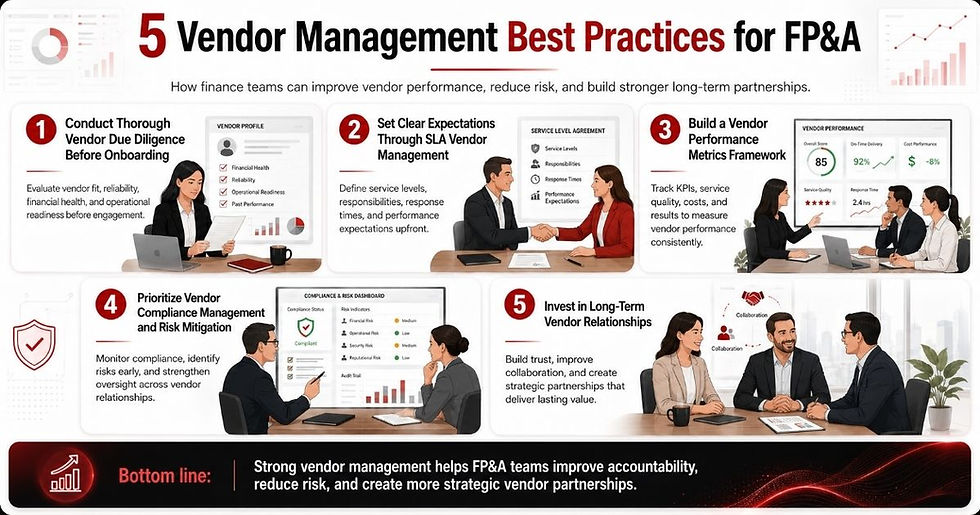
5 Vendor Management Best Practices for FP&A

Vendor management best practices help FP&A teams reduce costs, improve vendor accountability, strengthen compliance, and build more reliable procurement operations. As finance teams become more involved in procurement strategy and risk oversight, strong vendor management processes are becoming essential. When handled well, costs stay predictable, quality stays consistent, and strategic decisions are grounded in reliable data. When it isn't, you're left chasing invoices, disputing SLA breaches, and explaining budget overruns to leadership.
This guide covers five vendor management best practices every FP&A team should put into action.
1. Conduct Thorough Vendor Due Diligence Before Onboarding
One of the most overlooked vendor management best practices is front-loading the work. Finance teams that skip proper vendor due diligence often pay for it later through service failures, compliance violations, or unexpected financial exposure.
Before signing any agreement, assess a prospective vendor across three dimensions:
Financial Health
Review credit history, financial statements, and any publicly available indicators of stability. A vendor that looks attractive on price may not be able to sustain service delivery if their finances are shaky.
Operational Track Record
Request references, review case studies, and look at their history with similar clients. Past performance is often the most reliable predictor of future performance.
Regulatory Compliance
Confirm the vendor meets relevant legal and industry standards. This is especially important in highly regulated industries where a vendor's non-compliance can create liability for your organization.
Vendor due diligence shouldn't stop at onboarding. Scheduling periodic compliance reviews (annually at a minimum) keeps your vendor base current and surfaces issues before they escalate.
2. Set Clear Expectations Through SLA Vendor Management
A finance procurement strategy is only as strong as the agreements backing it. Service level agreements (SLA) are the foundation of vendor accountability, translating expectations into measurable, enforceable terms.
Effective SLA vendor management means going beyond boilerplate contracts. Your SLAs should reflect your actual business priorities, whether that's cost containment, turnaround time, reporting quality, or uptime. If cost reduction is a core FP&A objective, build that into the vendor agreement through incentive structures or performance-linked pricing.
Strong SLAs Include:
Specific, measurable performance targets tied to vendor KPIs.
Clear escalation paths and dispute resolution procedures.
Flexibility clauses that allow terms to adapt as business needs shift.
Defined review cadences so both parties stay aligned over time.
Bringing legal and finance expertise into contract negotiations isn’t optional, it’s how you protect the organization’s financial interests and make sure agreements hold up when tested.
3. Build a Vendor Performance Metrics Framework
You can't manage what you don't measure. How FP&A teams manage vendors effectively often comes down to whether they have the right vendor performance metrics in place, and whether those metrics are actually being reviewed.
Choosing the Right Vendor KPIs
Vendor KPIs should be tailored to what each vendor actually delivers. Common categories include:
Delivery and Reliability — Are goods or services arriving on time and at the agreed standard?
Cost Performance — Are invoiced amounts consistent with contracted rates? Are there patterns of overruns?
Responsiveness — How quickly does the vendor address issues or requests?
Compliance — Is the vendor meeting regulatory and contractual obligations consistently?
How to Track Vendor Performance
How to track vendor performance effectively comes down to infrastructure. Vendor management platforms with real-time dashboards make it easier to spot declining performance before it triggers a larger problem. Regular review meetings (focused not just on what went wrong but on what's working) also help FP&A teams maintain a clear picture of vendor health across the portfolio.
When performance drops below agreed thresholds, address it promptly. Frame the conversation around root causes and shared problem-solving rather than blame. Vendors who feel like partners are more likely to course-correct quickly and communicate proactively when challenges arise.
4. Prioritize Vendor Compliance Management and Risk Mitigation
FP&A teams sit at the intersection of financial oversight and operational risk, which makes vendor compliance management a natural part of the function. A vendor failure (whether financial, operational, or reputational) can have cascading effects on budgets, timelines, and stakeholder confidence.
Types of Vendor Risk to Monitor
Financial Risk — Can the vendor sustain operations and commitments if their own business faces pressure?
Operational Risk — Do they have contingency capacity if demand spikes or disruptions occur?
Reputational Risk — Are their business practices consistent with your organization's standards?
Building a risk-tiered vendor map (categorizing vendors by criticality and exposure) helps the finance procurement strategy stay focused. High-risk, high-dependency vendors warrant more frequent monitoring and stronger contingency planning.
Regular vendor compliance reviews are the operational expression of this approach. They keep the vendor base accountable, ensure regulatory requirements are being met, and provide the documentation trail needed if issues arise.
5. Invest in Long-Term Vendor Relationships
The most durable vendor management best practices for FP&A aren't just about oversight, they're about partnership. How to improve vendor relationships often starts with a shift in posture: treating key vendors as strategic allies rather than transactional suppliers.
Long-term vendor relationships tend to produce better outcomes across the board. Vendors who trust the relationship are more likely to offer flexible terms during difficult periods, flag risks proactively, and bring forward ideas that improve efficiency or reduce cost.
The practical mechanics of relationship-building include:
Regular communication that goes beyond performance reviews; check-ins focused on plans and shared goals.
Recognizing and acknowledging good performance, not just escalating problems.
Including vendors in relevant planning conversations when their input adds value.
Being transparent about how your organization's needs are evolving.
For FP&A, this translates directly into better budget predictability, more reliable forecasting inputs, and stronger negotiating leverage when contracts come up for renewal.
Why Strong Vendor Management Drives Better FP&A?
Effective FP&A vendor management is an ongoing discipline built on due diligence, clear agreements, consistent measurement, active compliance oversight, and relationship investment. Finance teams that treat these five practices as integrated rather than isolated will find that vendor relationships become a genuine source of operational strength. The payoff is better data, lower costs, and a vendor base that supports, rather than complicates, the broader finance and procurement strategy.


